
What Is Milk Glass? A Collector’s Guide
A closer look at the soft white glass that has filled kitchens, cabinets, and collections for generations.
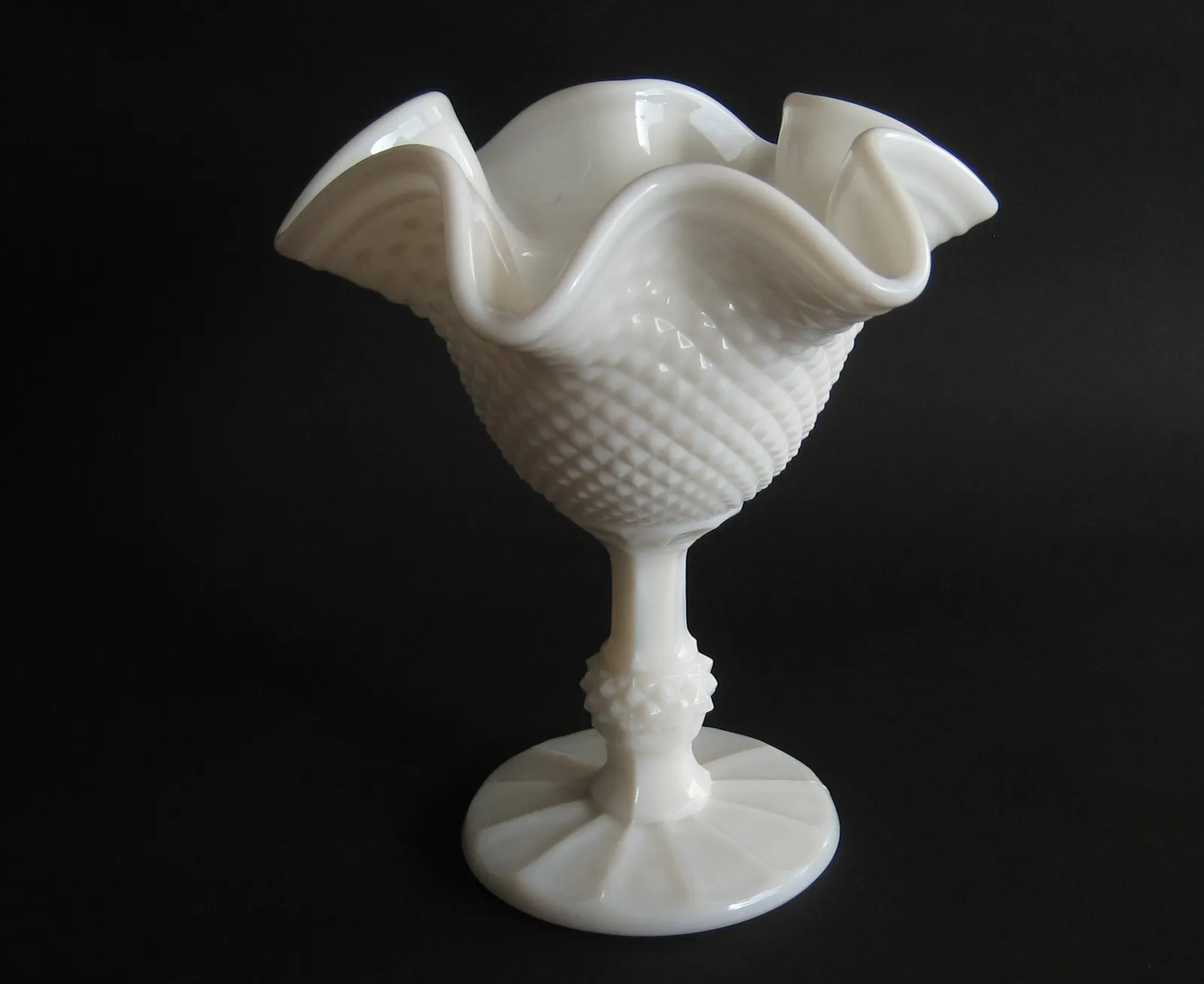
Milk glass is one of those materials that can feel familiar before you know its name. You may recognize a ruffled vase on a grandmother's shelf, a covered candy dish in an estate-sale box, or a small pedestal bowl that seems to glow even in a dim room. Its white surface is quiet, but the shapes are often anything but. Hobnails, grapes, lace-like edges, swirls, panels, and scallops turn a simple opaque glass into a piece worth picking up for a second look.
For collectors, milk glass is appealing because it offers plenty to learn without demanding that every piece be rare. It can be decorative, useful, affordable, and wonderfully specific to its era. The useful question is not simply whether something is old. It is what you are looking at, how it was made, what condition it is in, and whether it is a piece you will enjoy living with. This guide gives you a practical way to start.
Milk glass is opaque glass with a soft, milky look
Milk glass is glass made to look opaque or softly translucent rather than clear. White is the classic color, but it does not have the chalky, porous feel of plaster or ceramic. It has the smooth surface and reflected light of glass, often with a warm glow around a thinner edge. The look comes from ingredients used in the glass mixture to create opacity. The result can range from dense white to a softer, more luminous finish that seems to hold light inside the piece.
The term describes a type of glass, not one maker, one pattern, or one exact date. That is why a tiny plain dish and an ornate pedestal compote can both be milk glass. The 20th Century Glass Encyclopaedia's overview of milk glass is useful background when you want to understand its longer history and different names. For a collector at home, the practical takeaway is simpler: observe the whole piece before assigning an age or a maker.
Milk glass is sometimes confused with white ceramic, porcelain, or an opaque pressed-glass look-alike. Start at the rim, foot, handle, and any thin edge. Glass usually catches light differently and may show a faint glow where it thins, while ceramic has a different body and often a distinct glazed finish. Do not force the answer from one clue. A careful look at material, pattern, construction, and any mark will get you much farther.

Learn to recognize the shapes and patterns first
Milk glass was made in many forms: vases, bowls, goblets, candlesticks, covered dishes, mugs, plates, compotes, lamps, baskets, and small novelty pieces. Begin with the object's job. A covered dish may have been made for candy, butter, or sugar. A tall pedestal bowl may be a compote. A very small open dish may be a trinket or dresser dish. Getting the form right gives your research a useful starting point before you search for a pattern name.
Then describe the surface in ordinary words. Hobnail means raised rounded bumps. Grape patterns may include leaves, vines, or clusters in relief. Paneled pieces have repeated vertical sections. Ruffled, crimped, or scalloped edges change the outline. Some pieces are smooth and architectural, while others are dense with pressed decoration. A plain description such as “white pressed-glass pedestal bowl with hobnail texture and a ruffled rim” is more reliable than a confident maker name you have not yet proven.
Look at where the pattern begins and ends. Does it run all the way to the foot? Is the base smooth, ridged, or molded? Do the raised details repeat evenly? Does a lid fit its base cleanly, and does the finial match the style of the dish? These questions do not just help identify a piece. They also reveal damage, replacements, and near-matches that can be easy to miss in a quick online listing.
Age is a useful clue, but it is not a shortcut
Milk glass has a long history, and pieces from different decades can borrow familiar-looking details. Victorian examples, early twentieth-century pressed glass, mid-century tableware, and later revival pieces may all appear in the same cabinet. That overlap is part of what makes collecting interesting, but it also means a ruffled rim or a grape pattern does not settle the date by itself.
Instead, build a small case from several observations. Record the form, dimensions, pattern, color, mold seams, base, maker mark, surviving label residue, and any paperwork that came with the piece. Check whether the object looks hand-finished or more uniformly molded. Compare the complete shape and proportions with trusted reference images, not only the most similar-looking front view. A related pattern can be lovely, but it is still different from an exact match.
When Fenton is a possible maker, use the same discipline. Fenton made memorable milk glass and other opaque pieces, but other makers worked in comparable forms. Our guide to identifying Fenton glass explains why a mark, pattern, shape, and condition should agree before you treat an attribution as settled. A cautious description is not less useful. It is the kind of information another collector can trust.

Inspect condition before you fall in love with the pattern
Opaque glass can disguise flaws until the light reaches it just right. Take the piece near a window or a bright wall and turn it slowly. Check the rim, feet, handles, lid edge, finial, and raised points for chips, flakes, cracks, roughness, repairs, and worn decoration. A fingertip can help find a tiny rim nick, but move gently. A sharp edge can cut, and delicate pieces do not benefit from hard handling.
Look for cloudiness, staining, or surface wear, especially inside bowls and around a foot. Some marks are ordinary signs of age, while a crack, a deep chip, or a repaired handle changes how a piece should be priced and used. A small, honestly disclosed base nick may be perfectly fine for a cabinet display. A crack at a drinking rim or a loose lid deserves much more caution. Condition is not about making every item perfect. It is about understanding what you are bringing home.
Completeness matters too. A covered dish is more useful and often more desirable with its original lid. A lamp needs a stable base and appropriate hardware. A matched pair is not automatically better than one piece you truly love, but it is worth checking that two pieces are actually the same pattern, size, and color. Take a moment to compare them side by side before assuming they belong together.
Identify first, then think about value
It is tempting to search for a price before anything else. That can make an expensive listing look like evidence, even when the seller has guessed at the maker or pattern. A better order is to identify the material and form, describe the pattern, compare reliable examples, and then look at recently sold pieces with similar condition. An asking price tells you what someone hopes to receive. It does not tell you what collectors have actually chosen to pay.
Value can depend on the maker, the pattern, rarity, size, color, condition, and whether the piece is part of a complete set. A dramatic centerpiece may be harder to find than a small dish, while a common pattern in flawless condition can still be a wonderful buy for someone who wants to use it. The most practical collecting rule is to separate financial value from personal value. A modest cream pitcher may be the right piece because it completes a table, recalls a family home, or simply makes you happy every time you see it.
For a wider framework, read our guide to what vintage glassware is worth. It walks through the same habit that serves milk glass well: make the identification as strong as you can, compare like with like, and leave room for uncertainty where the evidence is thin.

Use and care for milk glass conservatively
Milk glass can be both display-worthy and useful, but treat unfamiliar pieces with care. Hand-wash with mild soap and lukewarm water, support the body and base rather than a delicate rim or handle, and dry each piece separately on a padded surface. Avoid sudden temperature changes, harsh abrasives, and a crowded dishwasher. Those habits protect older finishes and reduce the chance of one piece knocking into another.
Be especially cautious with painted decoration, gilding, repairs, damaged edges, or food-service pieces whose materials and history are unclear. A decorative dish can look beautiful on a shelf without being asked to do the work of a serving bowl. Our vintage glassware cleaning guide gives a careful routine for cleaning and drying older pieces without rushing the process.
When it is time to put milk glass on display, give the forms room to read. White glass is particularly good against a darker wall, wood shelf, or colored textile because its outline and raised details show more clearly. A small group can be more compelling than a shelf packed full. See our guide to displaying vintage glassware for ways to arrange favorite pieces safely without losing their quiet character.
How Tucson Collectibles helps guests find pieces with character
The pleasure of vintage is in the individual object: the unexpected form, the surface that catches light, and the small details that make a piece feel unlike something made yesterday. Tucson Collectibles curates glass, china, and decorative finds with that eye, then gives guests clear photographs and honest condition details to make a thoughtful choice from home.
Browse the current collection when you are looking for a shelf accent, a table piece, or a gift with more story than a new replacement. If a listing catches your eye, use the same questions from this guide: what is the form, what details are visible, what condition is it in, and can you imagine it in your home? That is a much better starting point than chasing a label alone.
Frequently asked questions
Is milk glass always white?
No. White is the color most people mean when they say milk glass, but opaque glass in pale blue, pink, green, black, and other colors can also be found. Look at the opacity and surface character first, then use color as one clue rather than the whole identification.
How can I tell milk glass from white ceramic?
Start with the edges, base, and any thin area near a rim or handle. Glass often shows a different translucency and has a smoother, more continuous surface than ceramic. A maker mark can help, but shape, seams, pattern, and construction should support the conclusion.
Is old milk glass valuable?
Some pieces are more sought after than others, but age alone does not determine value. The maker, pattern, rarity, condition, size, completeness, and current demand all matter. Identify the piece before using prices as a guide.
Can I put milk glass in the dishwasher?
Hand-washing is the cautious choice for older or unfamiliar milk glass. A dishwasher can be hard on delicate edges, painted decoration, gilding, older finishes, and repaired pieces. Use mild soap, a soft cloth, and enough space to keep pieces from knocking together.
Related posts
Milk-glass photographs: Manfred Heyde, Pete unseth, and Illarion Kalashnikov, used under Creative Commons Attribution-ShareAlike licenses.
Find a piece with a soft glow.
Browse vintage glass, china, decor, and one-of-a-kind finds in the current Tucson Collectibles collection.
Shop Vintage