
How to Identify Fenton Glass Marks & Colors
The best Fenton identifications come from a few honest clues working together, not from one hopeful glance at the bottom of a bowl.
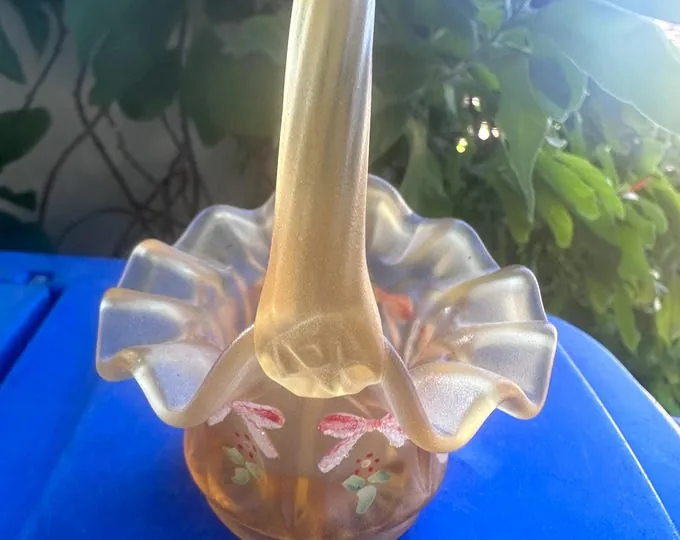
Fenton glass is easy to admire and surprisingly easy to misidentify. A ruffled rim, bright color, hobnail texture, or little basket may look familiar enough to inspire a quick answer, but many American glassmakers worked in overlapping shapes and finishes. A good identification takes a slower approach. Start with what is physically in front of you, then use the mark, construction, pattern, measurements, and reliable comparisons to test the story.
This guide is for the person who found a vase at an estate sale, inherited a dish, or wants to shop more confidently online. It is not a promise that every colorful piece is rare, and it is not a pricing shortcut. The useful first goal is simpler: describe the object accurately enough that you can compare it with the right references and recognize when the evidence is strong.
Use a five-minute Fenton check
Before a search result or a seller’s label makes up your mind, work through these five clues. They answer the most common question, “Is this really Fenton?”, without turning one familiar detail into proof.
- Photograph the base in angled light. Look for a molded mark, a remaining label, and the shape of the foot or base.
- Name the form precisely. Record whether it is a basket, vase, bowl, compote, or another shape, then note the rim, handle, and surface pattern.
- Measure before comparing. Height, rim width, and base diameter help rule out near-matches that look right in a small photograph.
- Match more than color. Check the pattern, construction, and dimensions against reliable examples, not only the hue or a ruffled edge.
- Separate identification from condition and value. Once the attribution is sound, check for chips, cracks, paint wear, and sold examples of the same piece.
Begin with the whole piece
Before you turn the piece over, take in its silhouette. Is it a basket, bowl, vase, compote, bell, lamp shade, figurine, or tumbler? Note whether the edge is straight, crimped, scalloped, ruffled, or folded. Notice the foot, handle, lid, and any applied decoration. A shape is often more useful than color alone because the same color can appear across a wide range of makers.
Write down a plain description before searching. “Opalescent pink basket with a flared rim, clear handle, and raised dots” is far more useful than “old pink glass.” Include height, widest diameter, base diameter, and the number of panels, petals, or lobes when those details are visible. Good measurements quickly eliminate near-matches that look convincing in a small photo.
Take photos in indirect daylight from the front, back, both sides, base, rim, and handle attachments. Photograph any label residue or mark at close range, then take one wider image to show exactly where it sits on the object. A single dark phone photo of a base rarely settles anything. Several clear views make it easier to compare a candidate pattern without relying on memory.
Check for labels, molded marks, and signatures
Look on the base first, but do not stop there. Turn the glass slowly under a light and inspect the lower edge, the inside of a lid, the underside of an applied handle, and the spot where a foot meets the bowl. A mark can be shallow, partially hidden by texture, or difficult to see in opaque glass. A flashlight held low across the surface can reveal details that direct overhead light misses.
Many collectors know the oval Fenton logo, yet a missing logo is not an automatic no. Fenton used paper labels on many pieces, and labels are easily lost to washing, handling, and time. Some pieces may also carry an artist signature, decorator signature, or original box information. Treat any surviving label or paperwork carefully. It can be one of the strongest clues, but it should still agree with the physical object.
When you find a mark, photograph every letter, number, and symbol rather than trying to interpret it immediately. The Museum of Fenton Art Glass preserves the company’s history and is a worthwhile starting point for understanding why provenance and period details matter. Compare a mark against more than one reliable reference, especially if it is faint or if the seller’s description seems unusually confident.
Read the pattern, not just the name
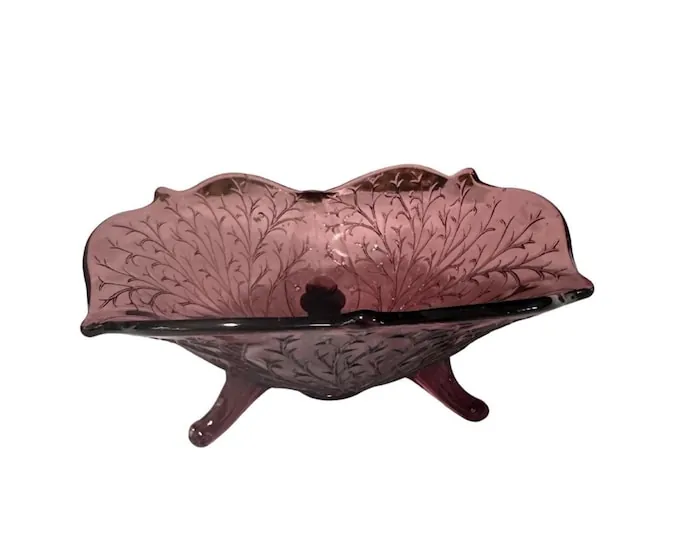
Fenton made pieces with memorable surface treatments, including hobnail texture, iridescent carnival finishes, opalescent edges, and hand-painted decoration. Those features are clues, not guarantees. Other companies made glass with dots, ruffles, milk glass, and bright colors too. What matters is whether several details line up at once: the exact form, the placement of texture, the rim, the base, the handle, the color, and the dimensions.
Hobnail, for example, refers to a raised all-over pattern of rounded bumps. On a candidate piece, look at how evenly the texture is arranged and how it meets the rim and base. On carnival glass, look beyond the shimmer. Record the molded pattern beneath the iridescence, the shape of the edge, and the placement of the design. On a basket, inspect the handle carefully. Its attachment points and profile can be more revealing than the body color.
Use descriptive terms that are true even if the maker turns out to be different. “Milk glass vase with a ruffled, clear edge” gives you useful search language. “Fenton vase” does not, unless you already have enough evidence. This small discipline helps prevent an early guess from becoming a permanent label in a collection.
Let color support the identification
Color is part of Fenton’s appeal, but it is one of the easiest clues to overvalue. Look at the glass in natural light against a plain white or neutral background. Note whether the color is solid, layered, translucent, opaque, iridescent, or concentrated at the edge. If there is a color transition, identify where it begins. A close description of the gradient can be more useful than calling a piece simply “blue” or “pink.”
Do not use color alone to date a piece or attach a maker’s name. Lighting, camera settings, and even the color of a table beneath the glass can change how it appears online. Instead, use color as a filter after you have recorded form and pattern. If a reference image agrees on the unusual rim, base, and dimensions as well as the color, you are moving toward a meaningful match.
Be equally careful with painted decoration. Hand-painted flowers, birds, or other details can add interest, but paint should be examined for wear, texture, and placement. Do not scrub, soak, or try to “improve” a decorated piece while you are identifying it. An original finish, even with honest signs of age, is part of the object’s story and condition.
Compare the base, rim, and construction
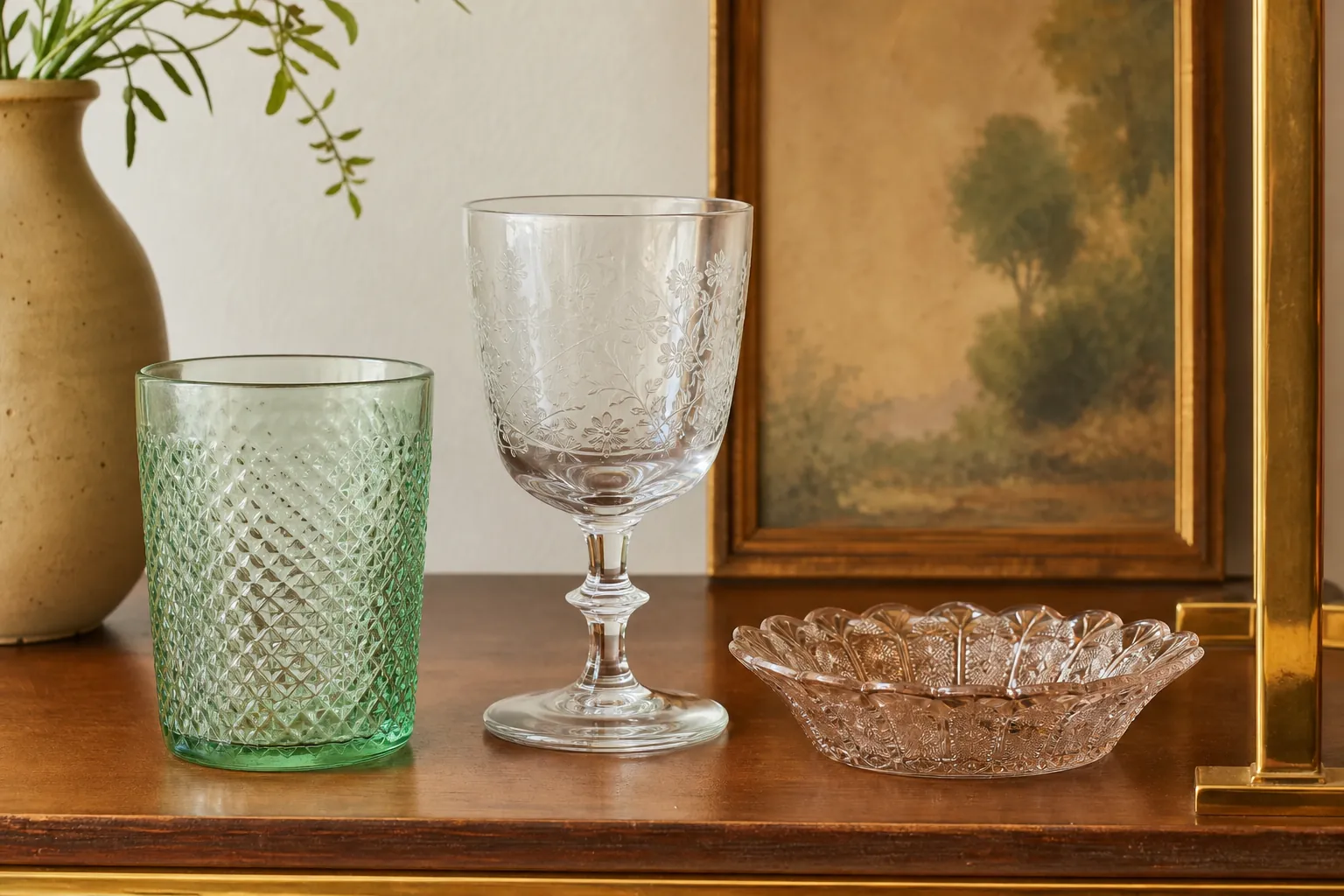
Once you have a possible pattern name, go back to the physical piece. This is where many false matches fall apart. Compare the base shape, whether it is smooth or patterned, the number of molded sections, the thickness of the glass, the profile of the rim, and any seams or applied elements. A pattern that looks right from the front but has a different foot or handle is probably not the exact piece.
Older glass can show mold seams, ground areas, or small irregularities from hand finishing. These are useful observations but not standalone proof of age or maker. One feature may have several explanations. The strongest identification is the one that accounts for the whole object without asking you to ignore an inconvenient mismatch.
Keep an eye out for damage while you inspect. Feel the rim gently for chips, check handles for cracks at the join, and hold clear or translucent glass up to a bright wall to look for repairs and hairlines. A small manufacturing ripple is different from a crack, and a bit of base wear is different from a fresh chip. Clear condition notes protect the next owner and help you decide whether a piece belongs on a shelf or in everyday use.
Use a deliberate comparison process
Search one descriptive phrase at a time, then refine it. Start with object type, surface pattern, edge treatment, and measurements. Add color only when you need to narrow results. Look for catalog images, museum records, established collector references, and multiple examples of the same pattern. A single marketplace listing can be a lead, but it is not proof. Sellers can repeat one another’s incorrect descriptions very quickly.
When you find a possible match, make a short checklist. Does the molded design line up? Does the rim have the same number of ruffles or panels? Are the measurements close? Is the color documented for that form? Is the mark or label consistent with the proposed period? If several answers are no or unknown, step back and keep the description open. “Possibly Fenton, attribution unconfirmed” is more useful than a confident error.
The broader vintage glassware identification guide offers the same method for pieces from any maker. It is a good companion when you are comparing a suspected Fenton item with pressed glass, cut glass, etched glass, or another form that may look similar at first glance.
Do not identify and value at the same time
It is tempting to search for a price as soon as a piece looks promising. Resist that urge. Asking “what is it?” and “what is it worth?” at the same time can make every expensive listing look like confirmation. First identify the pattern and maker as carefully as you can. Then compare recently sold examples with the same size, color, condition, and decoration.
Condition changes the picture. A crack, chip, repair, fading paint, haze, or missing lid can matter more than a broad pattern name. So can size. A small dish and a large centerpiece from a related line may have very different demand. Provenance, original labels, and a documented artist signature can also matter, but only when they are actually present and clearly connected to the piece.
Value is not the only reason to identify something. A modest bowl may still be the right piece for a table, a gift, or a shelf. Knowing what you have helps you care for it, describe it honestly, and enjoy the details that first made you pick it up.
Shop with the same collector’s eye
When you are considering a piece online, look for several angles, close-ups of the rim and base, accurate measurements, and clear condition notes. The current Fenton glass collection at Tucson Collectibles is a useful place to browse colorful bowls, baskets, and decorative finds with that mindset. Let the listing photos help you understand the piece before you decide whether it belongs in your home.
For any piece you bring home, keep a short record: where you found it, measurements, condition, marks, and the references that helped you identify it. That record is useful when you want to build a set, insure a collection, or simply remember why one small object earned its place. When it is time to display it, our guide to displaying vintage glassware can help you give it room to catch the light safely.
Identification gets easier with repetition. The important habit is not memorizing every pattern. It is learning to look closely, avoid easy assumptions, and let the evidence earn the name.
Frequently asked questions
Is all Fenton glass marked?
No. A missing molded mark does not rule Fenton out, especially on older pieces or items that originally relied on a paper label. Use the mark, shape, color, finish, and a reliable pattern comparison together before reaching a conclusion.
Where is the Fenton mark usually found?
Look first on the underside or base. Use daylight or a small flashlight held at an angle, because a shallow molded mark can disappear against patterned or colored glass.
What does Fenton glass look like?
There is no single Fenton look. Baskets, bowls, vases, and other pieces can have hobnail texture, ruffled or crimped rims, opalescent edges, iridescence, or hand-painted decoration. Those traits are useful starting points, but an accurate identification needs the exact form, base, measurements, and a reliable comparison as well.
Does a Fenton mark tell me the value?
A mark helps establish who made a piece, but value depends on the exact pattern, color, condition, size, scarcity, and current collector demand. Identification should come before pricing research.
How do I identify unmarked Fenton glass?
Start with a precise description, including shape, color, measurements, rim treatment, pattern, and any remaining label residue. Compare more than one feature with a trusted catalog or reference before calling it Fenton.
Related posts
Looking for a piece with character?
Browse the current selection of vintage glass, china, décor, and one-of-a-kind finds.
Shop Vintage