
American Brilliant Glass: A Collector’s Guide
The best way to appreciate this dazzling American glass is to slow down, learn its vocabulary, and let the details tell their story.
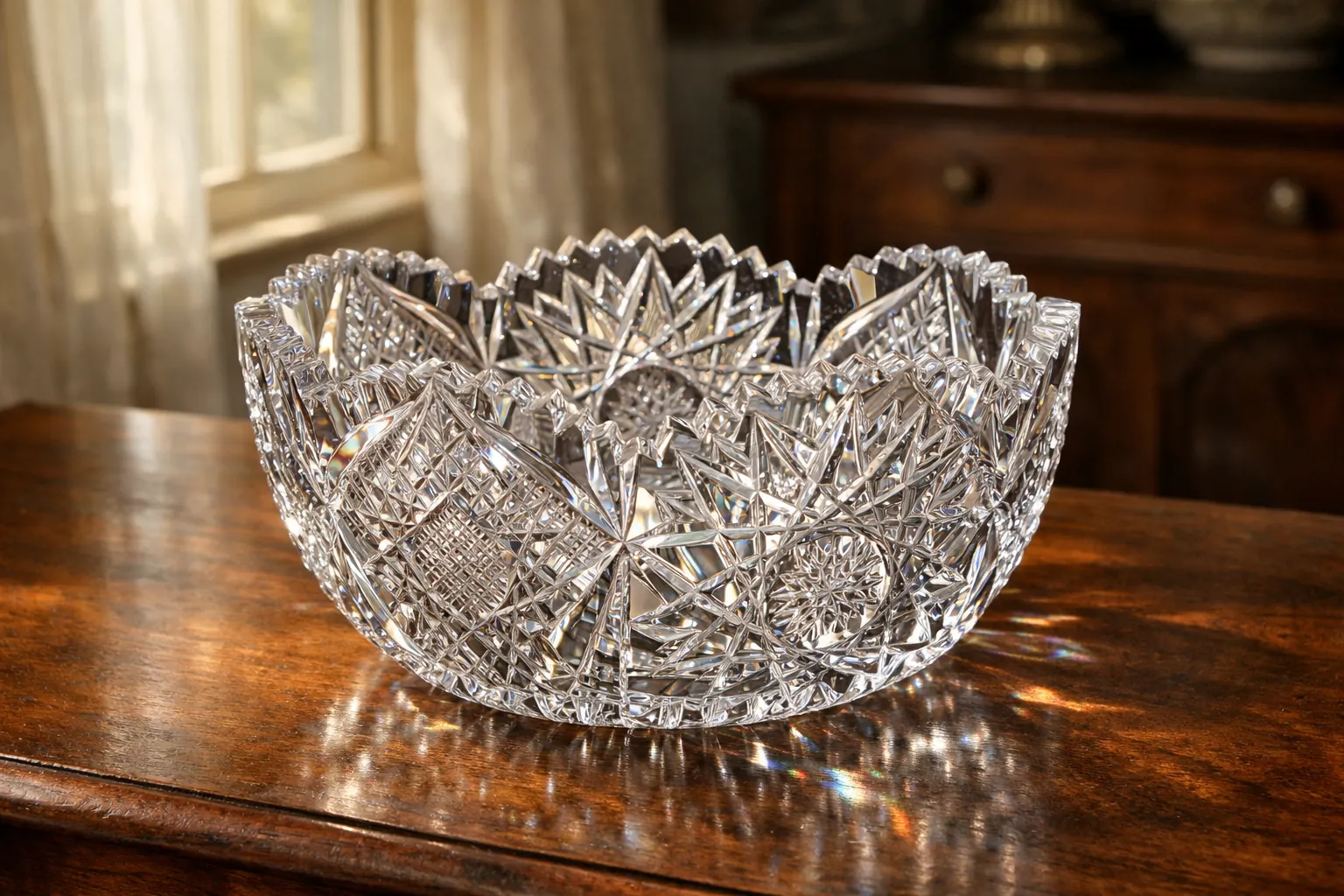
American Brilliant glass is the kind of object that makes a room pause. Light catches the sharp cuts, breaks into small flashes of color, and turns an ordinary bowl, pitcher, or decanter into something almost architectural. That drama is the point. During the American Brilliant Period, clear glass was cut by hand into dense geometric patterns meant to show off its clarity, weight, and sparkle.
It is also a category that rewards patience. Many later pieces borrow the look of rich cut glass. Many original pieces are not marked. And a dazzling pattern does not automatically answer the questions collectors care about, such as who made it, when, how it was cut, or how it should be valued. This guide gives you a practical starting point for recognizing the style, looking at it carefully, and enjoying it without pretending every sparkling dish has the same story.
What American Brilliant glass means
American Brilliant glass, often called American Brilliant Period cut glass or simply ABP, describes a high point in American cut glass from the late 1800s into the early 1900s. The period is commonly placed around 1876 to 1914 or 1916, depending on the reference. The American Cut Glass Association connects its beginning to the 1876 Centennial Exposition in Philadelphia, when American makers drew attention for richly cut domestic glass. The Corning Museum of Glass similarly places the American vogue for brilliant-cut glass roughly between 1880 and 1915.
The word brilliant describes the visual effect, not a single factory or pattern. Makers began with a clear glass blank, then cutters used wheels to grind facets and motifs into the surface. The finished piece could have stars, fans, diamonds, notches, flutes, strawberry-diamond fields, and tiny decorative cuts that turn one form into dozens of reflective planes. The quality is in the whole composition: clarity of the glass, confidence of the cutting, and the way the design works from rim to base.
These were luxury table and display pieces. Bowls, celery trays, decanters, pitchers, goblets, cruets, vases, and serving pieces gave a formal table plenty of light. Today, they can still be used as dramatic accents, but their appeal does not depend on recreating an entire period dining room. One bowl on a sideboard or a small grouping of goblets in a cabinet can bring the same sense of occasion.
Learn the cuts before you learn the names
New collectors sometimes begin by trying to memorize maker names. It is more useful to start with what is physically present. Look for a repeating set of shapes, then describe them plainly. A hobstar is a star-like form built from radiating cuts. Fans spread outward in a curved wedge. Strawberry diamonds are small diamond motifs set close together. Flutes are long, narrow cuts. Notches and scallops often energize a rim.
Those words are a useful visual language, not a magic answer key. A pattern may combine several motifs, and motif names can vary in collector references. What matters is being able to notice the relationship between them. Is a large hobstar centered in the base? Do fans repeat around the shoulder? Is the rim plain, scalloped, or deeply notched? Does the design become denser toward the bottom? A careful description makes your next comparison much more specific than a search for “old crystal bowl.”

Deep, crisp cutting is often part of the appeal, but do not test glass by running a finger hard along an edge. It is easy to chip a delicate rim or hurt yourself on a damaged point. Use reflected daylight and look across the surface. Strong cuts create distinct planes that catch and release light as you rotate the piece. Softer molded decoration may look similar at first glance, but it usually reads differently once you study the transitions and the complete pattern.
How to separate a promising piece from a look-alike
The first question is not “is it valuable?” It is “what exactly am I looking at?” Pressed glass, later cut glass, and imported crystal can all be handsome. They are simply not automatically American Brilliant. A piece with molded diamonds or stars may imitate the style without having been wheel-cut after it was made. A more recent crystal decanter may be carefully cut but belong to a different country and era.
Start by examining the pattern as a system. On a cut piece, the decoration was applied to a finished blank, so it should flow convincingly across the form. Look closely at the rim, base, foot, handle attachments, and areas where patterns meet. A pattern that looks strong only on the front but becomes vague at the base deserves more research. So does a piece whose surface has lots of sparkle but no coherent arrangement of motifs.
Then record simple facts: height, widest diameter, base diameter, weight if practical, number of pieces, and any ground areas or surviving labels. Photograph the whole object, the base, the rim, and every area that feels unusual. The method in our guide to identifying vintage glassware works especially well here. Details that feel fussy at first are what keep you from settling for a near-match later.

Marks can help, but they are not the whole case
Some American Brilliant pieces carry a signature or a mark, while many do not. A signature can be valuable evidence, especially when it agrees with the form and pattern, but it is not a shortcut around looking closely. Marks may be faint, polished away, partly hidden by a foot, or simply absent. The lack of a mark is a reason to keep researching, not a reason to confidently dismiss or assign a maker.
Look at the bottom in indirect light. A small flashlight held from the side can make a faint wheel-cut signature or mark easier to photograph. Do not scrub, scratch, or polish in an attempt to reveal something. A clean image is better than an altered surface. If you find a possible maker name, compare several documented examples before deciding it is a match. The American Cut Glass Association’s overview of the period is a helpful reminder that hundreds of cutting shops produced a vast number of patterns, many of which remain difficult to attribute with certainty.
This is where honest language matters. “American Brilliant style cut-glass bowl, maker unconfirmed” is a good description when the evidence is still open. It tells another collector what you see without turning a hope into a fact. If you have a signed piece, retain any history that came with it. Family notes, original boxes, older catalog references, and clear photographs can become useful parts of the object’s record.
Condition changes the conversation
Richly cut glass can hide flaws beautifully until the light hits it the wrong way. Before buying or using a piece, check the rim, points, handles, feet, stoppers, and every applied detail. Look for chips, roughness, cracks, cloudy areas, deep scratches, ground-down repairs, and mismatched parts. A decanter with its correct stopper is a different proposition from one with a replacement that merely fits. A bowl with a tiny base nick may still be a lovely display piece, while a crack near a handle or drinking rim deserves more caution.
Rotate the glass against a pale background. Haze and internal cracks show more readily there than on a crowded shelf. On a heavily patterned piece, let light travel across one section at a time. Be especially gentle with sawtooth rims and fine points. They are part of the beauty, but they are also vulnerable. Our vintage glassware cleaning guide explains a careful hand-washing routine that protects delicate surfaces better than a dishwasher or aggressive cleaner.
Condition is not a verdict on whether a piece deserves a home. It helps you decide how to enjoy it. A pristine centerpiece may suit a formal table. A glass with an old, disclosed flaw might be happiest in a cabinet, where the pattern can still catch the afternoon light without being asked to do more than it should.
Value comes after identification
Once you have described the piece carefully, you can begin to think about value. Maker, pattern, form, size, condition, completeness, and current collector demand all matter. A common form can be more useful in an uncommon pattern. A large punch bowl may be more difficult to find than a small dish. A matched set of stemware, a covered piece with its correct lid, or a decanter with its stopper can attract more interest because replacement parts are not always easy to find.
Use sold examples rather than asking prices when you can. Match the maker or probable maker, then compare the pattern, size, condition, and whether all parts are present. One dramatic listing is not a market. Three or four honest comparisons, even if they show a range, teach you much more. Our guide to what vintage glassware is worth walks through the same practical checks for any glass find.
Leave room for uncertainty. Some of the most appealing American Brilliant pieces are unsigned or hard to identify exactly. That does not make them lesser objects. It simply means a responsible seller or collector keeps the claim modest until better evidence appears. The point of research is not to force every piece into a famous name. It is to understand what makes the piece itself worth noticing.

Enjoy the sparkle without overworking the glass
American Brilliant glass earns its drama from light, so give it room. A single bowl can anchor a dining table, a decanter can lift a bar tray, and a small group of goblets can make a cabinet feel collected rather than crowded. Keep pieces away from busy edges where handles and points can be bumped. Avoid harsh, direct sun for long periods if the setting also includes delicate textiles or other antiques, and never stack cut-glass pieces without protection.
When you move a piece, support the body and base instead of lifting it by a handle, rim, or stopper. Use a soft, padded surface when you inspect it. If you are setting a table, choose sound pieces and leave a little space between them. For more display ideas, see our guide to displaying vintage glassware at home. The goal is not perfection. It is making it easy to enjoy the play of light without putting a fragile object in the path of daily chaos.
Finding glass with a story
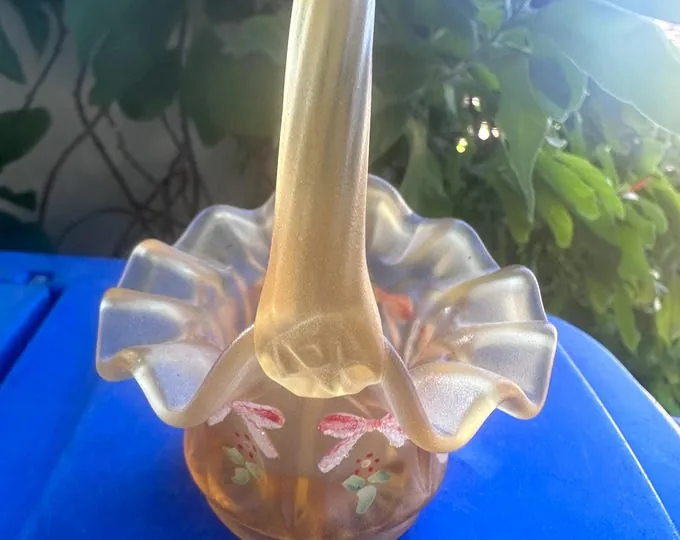
At Tucson Collectibles, we believe the best vintage find is the one that holds your attention after the first sparkle. That can be a formal cut-glass piece, a colorful Fenton basket, or a simple bowl with a shape you have not seen before. Clear photographs, honest condition notes, and enough time to look closely help a collector make a choice they will enjoy living with.
Browse the current collection for glass, china, and decorative finds, or visit the Fenton glass collection if color and art glass are calling your name. The piece does not need to be the rarest thing in the room. It needs to be a piece you are glad to see every day.
Frequently asked questions
What years are considered American Brilliant glass?
Collectors generally use American Brilliant Period for richly cut American glass made from the late nineteenth century into the early twentieth century. Exact date ranges vary by reference, so identify the piece by its construction and pattern before relying on a date alone.
Is all American Brilliant glass marked?
No. Many pieces are unsigned, and a missing signature does not settle the question either way. The most reliable approach is to compare the complete pattern, shape, measurements, and construction with reputable references.
How can I tell cut glass from pressed glass?
True cut glass has decoration ground into the surface after the blank was made. Pressed glass is shaped in a mold, so its pattern is formed as part of production. Look for crisp cut facets and a pattern that makes sense across the whole piece, but avoid relying on one clue alone.
Can American Brilliant glass be used?
A sound piece can be enjoyed with care, but do not assume every older glass object is suitable for regular food or drink service. Check for damage, unstable decoration, and previous repairs, then hand-wash gently and avoid sudden temperature changes.
Related posts
Find a piece that catches the light.
Browse vintage glass, china, decor, and one-of-a-kind finds in the current Tucson Collectibles collection.
Shop Vintage