
Vintage Egg Coddlers, Including Royal Worcester
Small, lidded, and wonderfully specific, an egg coddler turns a simple breakfast ritual into a collectible object worth noticing.
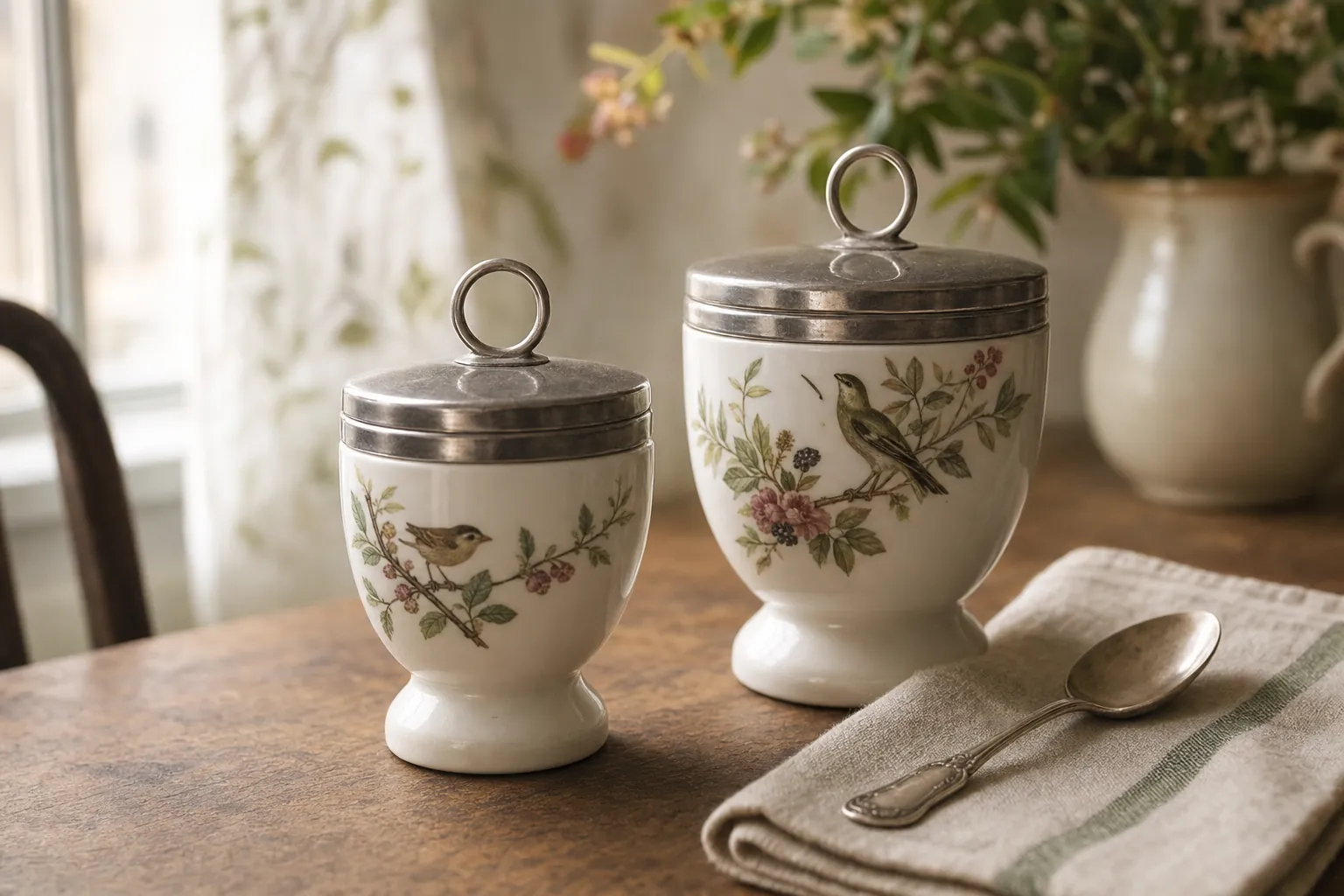
A vintage egg coddler has an immediate kind of charm. It is a modest piece of tableware, usually a porcelain cup with a fitted metal lid, yet it carries a surprisingly rich mix of domestic history, design, and useful purpose. For some collectors, the draw is the pattern. For others, it is the satisfying weight of the lid, the small ring handle, or the idea that a beautiful object was made for an ordinary morning at home.
Royal Worcester examples are especially appealing because the maker produced coddlers across many decades, patterns, and sizes. They are also a good reminder not to rush an identification. A coddler can be charming without being rare, and a clear maker’s mark is more useful than a hopeful guess. Start with the object in your hand, look carefully at its construction and condition, then let the details lead the story.
What makes a coddler different from an egg cup?
An egg cup is a serving piece. It supports a cooked egg while it is opened and eaten. An egg coddler is a cooking vessel. The egg goes inside the porcelain body, the lid closes over the top, and gentle heat does the rest. That lid is the quickest visual clue. Most vintage coddlers have a metal screw-top cover, often with a ring that helps lift it. The body is deeper and more enclosed than a typical egg cup.
That difference matters when you are browsing a flea market, estate sale, or online listing. Small lidded vessels are often described loosely. A condiment pot, storage jar, or decorative jar can look tempting, but it may not be an egg coddler at all. Look for the simple, compact form: a porcelain cup sized for an egg, a lid that fits the rim securely, and a design that feels practical rather than merely ornamental.
Part of the appeal is that the function remains legible. Even displayed on a shelf, a coddler looks like something made to be picked up and used. It brings a little ceremony to breakfast without demanding a formal table. That useful history gives it more presence than an object made only to decorate.
Royal Worcester and the “Premier Egg Cup”
Royal Worcester is one of the names most closely associated with the egg coddler. According to the Museum of Royal Worcester’s coddler research, the first known Worcester coddlers were made at Grainger’s China Works in the 1880s. The museum also notes that the Royal Worcester factory ledgers listed egg coddlers as “Premier Egg Cups” from 1910 through 1928. The name may sound odd today, but it reflects how closely the form sat beside English breakfast tableware.
Royal Worcester made the form its own through pattern. You may find crisp blue-and-white designs, fruit and floral decoration, birds, solid colors, and more formal tableware motifs. The Museum of Royal Worcester has recorded more than one hundred designs, which is why pattern can be such an enjoyable entry point. It is also why pattern alone is not enough to establish an exact date. The same general style can appear on pieces from different years, and a familiar name on a listing is not a substitute for looking at the base.
The maker also changed materials over time. The museum records the introduction of Royal Worcester Fireproof Cooking Porcelain in 1931, developed to handle thermal shock. For a collector, that history explains why these small pieces were not treated as novelty china. They were intended to move from kitchen ritual to breakfast table, bringing decoration and function together in one very compact object.

Read the form before you read the pattern
When evaluating a vintage coddler, begin with its structure. The porcelain body should sit evenly and the lid should meet the rim without looking forced. The lid’s metal parts deserve an unhurried inspection. Check the threading, the ring handle, and the area where metal meets porcelain. A little age to the metal can be attractive. A lid that is bent, badly corroded, cross-threaded, or loose is a different matter, especially if you hope to use the piece.
Early examples can look different from later ones. The Museum of Royal Worcester points out that very early Grainger coddlers have flat covers without ring handles. That is a helpful clue, not a shortcut. It is better to describe what you can see than to assign a precise year from one feature. An informed listing will show the top, side, and underside, and it will say whether the lid turns smoothly.
Size is worth noting too. Royal Worcester commonly made standard and King sizes, with a larger Maxime size produced for some designs between 1973 and 1988. If you are building a pair, compare the height and diameter rather than trusting a title alone. A matched pattern can still include different sizes, and that may be delightful for a breakfast table or frustrating for a collector expecting a true pair.
Marks are a starting point, not a finish line
The underside is where the conversation becomes more specific. A maker’s mark can confirm Royal Worcester, distinguish earlier Grainger pieces, and sometimes narrow the period. It also gives you a reason to slow down. Marks on a small coddler base can be faint, partially worn, or difficult to photograph, so ask for a clear image before relying on a seller’s transcription.
The Museum of Royal Worcester outlines several useful mark periods. Grainger examples from 1890 to 1902 may show a shield and a year letter. Around 1902 to 1930, Royal Worcester pieces may include Crownware in a ribbon or the words Royal Worcester Vitreous. From 1931 into the middle of the century, “Royal Worcester England” often appears in straight green lines. Later pieces may use a scrolled W in a circle, followed by a standard black Royal Worcester mark. These are useful guideposts, but the museum rightly cautions that coddler marks do not vary dramatically because the base is so small.
In practical terms, use the mark to support the rest of the evidence. Does the body, lid, size, decoration, and condition make sense together? Is the pattern named in a way that can be confirmed? Are there signs of alteration or a replacement lid? A good collection grows through patient, repeatable observations, not a single exciting stamp.

Condition tells you how to enjoy it
On porcelain, check the rim, interior, base, and any raised edges for chips, hairline cracks, staining, or repair. Turn the piece slowly in good light. A hairline can hide in a busy pattern, while a chip on the rim may be easier to feel than see. Crazing, the fine network of lines in a glaze, deserves a close look as well. It may be acceptable on a display piece, but it changes the decision if you are buying for regular kitchen use.
Inspect the metal lid separately. It should fit and turn with reasonable ease, without scraping hard against the porcelain. Do not force a stuck lid. A lost or mismatched cover changes both the look and the function, though a lidless body can still make a lovely little holder for flowers, salt, or a single small keepsake. The point is to buy it for the life it can honestly have now.
Condition should also shape price expectations. A pristine, complete coddler may be worth holding out for when you want one to use. A piece with a small flaw can be a more relaxed way to enjoy a favorite pattern. Neither choice is morally better. The right one is the one whose condition, price, and purpose agree.
Using a vintage coddler with care
A sound coddler can still make breakfast feel special, but older porcelain earns a gentle approach. The Museum of Royal Worcester’s historic care guidance recommends standing the vessel in a pan of boiling water with the water only halfway up the porcelain body, rather than fully submerging it. The same guidance says not to use these coddlers in a microwave or over a naked flame.
Before using any vintage example, inspect it again and consider its age, glaze condition, and lid. Avoid sudden temperature changes. Do not transfer a cold coddler directly into aggressively boiling water, and let it cool before washing. Hand washing is the sensible choice. A soft cloth, mild soap, and a patient rinse protect both the decoration and the quiet pleasure of using something with history.
If you are not certain the piece is sound, let it be decorative. A coddler can hold a tiny posy, a few wrapped sweets, or simply sit among other vintage china where its pattern can be enjoyed. A collectible does not have to perform its original job every day to earn its place at home.

Build a collection that feels like yours
There are many good ways to collect egg coddlers. You might follow one pattern, gather a small group of birds or botanicals, look for a standard and King pair, or choose examples only when the condition is especially good. A single Royal Worcester coddler can be a charming starting point. A shelf of them in mixed patterns can feel collected rather than matched, which is often more interesting.
Keep the details with the piece when you can. A saved listing photo, pattern name, measurements, and notes about condition will make the collection more satisfying later. It also helps if you decide to gift or pass along an item. The same patient attention applies to any delicate tableware, including the glass pieces in our note on cleaning vintage glassware.
Find pieces with a story at Tucson Collectibles
Tucson Collectibles is built around useful, beautiful objects that bring personality to a home. Browse the current collection for vintage china, glass, and decorative finds, or explore the collections when you want to follow a particular material or mood. The best vintage piece is not always the rarest one. Often, it is the object you notice twice and can already imagine using or displaying.
Frequently asked questions
What is an egg coddler?
An egg coddler is a small lidded vessel, usually porcelain or pottery, made for gently cooking an egg in hot water. It is different from an egg cup, which simply holds a cooked egg for serving.
Did Royal Worcester make egg coddlers?
Yes. Royal Worcester made egg coddlers in many patterns and sizes. The Museum of Royal Worcester notes that the factory ledgers called them Premier Egg Cups from 1910 through 1928, and the company continued producing them in later decades.
Can a vintage egg coddler still be used?
A sound example can often be enjoyed gently, but condition comes first. Check for chips, hairline cracks, loose or damaged lid parts, and worn threads. When in doubt, keep a fragile or repaired piece for display.
What size egg coddler should I collect?
Choose the size that suits your interest and how you will use it. Royal Worcester commonly made standard and King sizes, while some later patterns also appeared in the larger Maxime size. A matched pair is lovely, but one appealing example makes a complete beginning.
Related notes
Find a piece worth setting out.
Browse vintage finds selected for collectors, gift givers, and homes with character.
Shop Vintage